

Introduction
Why Tuition Has Become Common in Singapore
Tuition has become a familiar part of education in Singapore. Competitive school environments, fast-paced syllabuses, and milestone examinations such as the PSLE, O-Levels, and A-Levels often lead parents to seek additional academic support for their children. Tuition can help reinforce school learning, close knowledge gaps, and improve confidence when subjects become more challenging.
As a result, parents today encounter many types of tuition options. Students may attend tuition centres, learn through online platforms, or engage private tutors for personalised lessons at home. Each format has its own strengths and limitations.
However, tuition decisions are often made based on convenience, recommendations from friends, or tutor availability. While these considerations are understandable, they do not always result in the most effective learning arrangement.
One important factor that parents sometimes overlook is that children learn differently. A format that works well for one student may not suit another. Some students need close guidance, while others benefit from peer discussion or independent learning environments.
This guide explores the main types of tuition available in Singapore and explains how learning behaviour, academic needs, and emotional readiness should influence tuition choices. By understanding both the tuition landscape and how their child learns, parents can make more thoughtful decisions that support long-term academic development.
In practice, tuition providers and agencies that work with a wide range of students often observe a consistent pattern: tuition tends to be most effective when the format aligns with how a child engages with learning, rather than how popular a programme appears.
Key Takeaways
- Singapore offers multiple types of tuition, including home tuition, tuition centre classes, online tuition, and hybrid models. Each format supports different learning preferences, levels of independence, and academic needs.
- Some children learn best through visual explanations, while others learn best through discussion or active problem-solving. Observing your children’s learning patternshelps parents identify tuition environments where the child is more likely to stay engaged and understand concepts.
- Two students in the same class may respond very differently to the same teaching format. Understanding how children learn differently allows parents to choose tuition that matches behavioural and emotional learning needs.
- Whether the goal is concept mastery, exam preparation, or confidence building, tuition should be selected based on the child’s current academic situation rather than following trends or recommendations alone.
- Working with a professional tuition agency in Singapore can help parents evaluate the different types of tuition and match tutors to their learning tendencies, academic level, and personality.
What Are the Main Types of Tuition in Singapore?
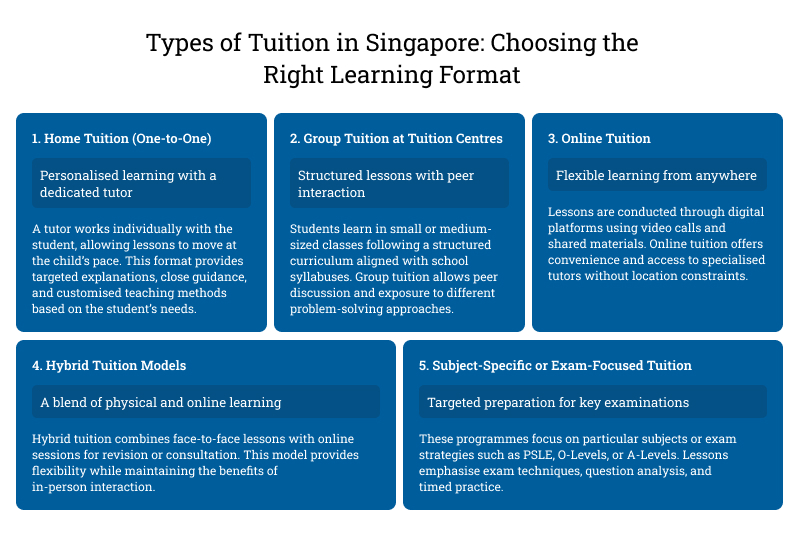
Singapore’s education landscape includes several common tuition formats. Each approach provides different levels of personalisation, structure, and interaction.
Understanding these options helps parents evaluate which format might best support their child’s needs.
Home Tuition (One-to-One Tuition)
Home tuition typically involves a tutor working individually with a student in a personalised learning environment. Lessons may take place at the student’s, or tutor’s home, or through virtual platforms.
Many families choose home tuition in Singapore when their child requires focused attention or customised teaching strategies. Because the tutor works with only one student, lessons can progress according to the child’s pace and level of understanding.
One key advantage of one-to-one tuition is the ability to address specific learning gaps immediately. Tutors can revisit difficult topics, adjust explanations, and provide detailed feedback without the pressure of keeping up with a class.
Students who struggle with confidence or who feel uncomfortable asking questions in group environments often benefit from this personalised approach. Tutors can also adapt teaching methods to match the students’ learning preferences.
However, one-to-one type of tuition also has some limitations. It may involve higher costs compared to group tuition, and students who rely too heavily on tutor guidance may take longer to develop independent study habits.
For many families, 1-to-1 home tuition in Singapore serves as targeted support rather than a long-term replacement for independent learning.
Group Tuition at Tuition Centres
Group tuition is typically conducted in tuition centres where students attend lessons in small or medium-sized classes. These lessons often follow structured programmes aligned with the Ministry of Education (MOE) syllabus.
This type of tuition format is popular among parents because it mirrors the classroom environment while providing additional explanation and practice. Tutors often focus on exam preparation, common question types, and reinforcement of school topics.
Group tuition can benefit students who enjoy learning with peers. When students hear others asking questions or attempting similar problems, they may feel less isolated in their struggles.
Discussion and collaborative learning can also reinforce understanding. Observing different problem-solving approaches allows students to see multiple ways of thinking about the same concept.
However, group tuition has limitations when students learn at different speeds. Tutors must balance the pace of the class, which means individual attention may be limited. Students who are shy or who have specific learning gaps may find it harder to keep up.
For this reason, the effectiveness of group tuition often depends on class size and the tutor’s ability to adapt lessons to varying levels of understanding.
Online Tuition
Online tuition has grown rapidly in Singapore in recent years. Digital learning platforms allow tutors to conduct lessons remotely using video conferencing tools, shared documents, and interactive whiteboards.
For families with busy schedules, online tuition offers convenience and flexibility. Students can attend lessons without travelling to a tuition centre, and tutors can be located anywhere.
Online tuition can also provide access to specialised tutors who may not be available locally. Some platforms offer recorded lessons or revision sessions that students can revisit before examinations.
This format works best for students who are comfortable with technology and able to concentrate independently. Older students in secondary school or junior college may find online learning convenient when balancing academic commitments.
However, younger students may struggle with sustained attention during virtual lessons. Screen fatigue and reduced interaction can affect engagement if lessons are not carefully structured.
When evaluating types of tuition that involve online learning, parents should consider whether their child canremain focused and motivated in a digital learning environment.
Hybrid Tuition Models
Hybrid tuition is a type of tuition that combines both in-person and online learning elements. Students may attend physical classes while using online sessions for revision, consultations, or supplementary support.
This format offers flexibility for families who want the benefits of face-to-face learning while maintaining adaptable schedules.
For example, a student might attend weekly group tuition at a centre while scheduling occasional online sessions for targeted revision before exams.
Hybrid arrangements can also help students maintain learning continuity during busy academic periods or school holidays.
However, the effectiveness of hybrid tuition depends largely on consistency. Students must be able to adapt to different learning environments without losing focus or structure.
Parents should therefore consider whether their child responds well to switching between formats before adopting this approach.
Subject-Specific and Exam-Focused Tuition
Some tuition programmes are designed specifically around certain subjects or examinations. Examples include PSLE preparation classes, O-Level revision courses, or specialised mathematics and science programmes.
These classes typically emphasise exam strategies, question analysis, and time management. Students practise answering common exam questions and learn how to structure their responses according to marking schemes.
Exam-focused tuition can be particularly helpful for students who already understand the subject content but need guidance on applying knowledge under timed conditions.
However, this format may not always address deeper conceptual gaps. If a student struggles with fundamental understanding, exam practice alone may not resolve the issue.
In recent years, educators have observed that many students are becoming more aware of their own academic performance and stress levels. This awareness creates opportunities for parents to have open conversations with their children about how they are coping in school and whether additional academic support may be helpful. This, therefore, becomes a way for parents to understand whether their child requires enrichment, remediation, or exam preparation when evaluating this type of tuition.
Matching Types of Tuition to Your Child’s Learning Style
Before examining specific learning preferences, it is useful to understand that learning styles are not fixed categories. A child’s learning style often reflects tendencies rather than strict classifications.
Many students benefit from multiple learning approaches over time. Preferences may change as children grow older, gain confidence, or encounter new subjects.
Nevertheless, observing how children respond to different teaching methods can provide useful insights when choosing between the different formats.
Children Who Learn Best Through Visual Explanations
Some students process information more effectively when concepts are presented visually. Diagrams, structured notes, charts, and worked examples help them organise ideas clearly.
For these learners, tuition formats that allow tutors to write, draw, and explain concepts step by step are often helpful.
One-to-one tuition or small-group tuition often works well because tutors can use visual aids and organise information clearly.
Online tuition can also support visual learners if tutors make effective use of shared screens, digital whiteboards, and annotated notes.
Certain types of tuition, like large group classes that rely heavily on verbal explanations, may be less suitable if visual reinforcement is limited.
Children Who Learn Through Discussion and Listening
Some students absorb information best through listening, explanation, and conversation. These students benefit from environments where they can ask questions, explain ideas aloud, and hear different perspectives.
Interactive types of tuition formats that encourage discussion can support these learners effectively.
Group tuition often works well for students who enjoy dialogue and collaborative learning. Hearing classmates’ questions can stimulate deeper thinking and reinforce understanding.
One-to-one tuition can also support auditory learners when tutors encourage verbal reasoning and explanation.
In contrast, highly independent or worksheet-heavy tuition formats may reduce engagement if opportunities for discussion are limited.
Children Who Learn Best Through Active Participation
Some students learn best by actively engaging with problems rather than listening to long explanations.
These students often prefer hands-on learning environments where they can practise concepts immediately and receive feedback.
Kinaesthetic learners may struggle in a passive lecture-style type of tuition lessons. Long explanations without interaction may lead to restlessness or loss of concentration.
One-to-one tuition can work well when tutors structure lessons around problem-solving activities and interactive questioning.
Small group classes can also support active learning if the tutor encourages participation and discussion.
However, large lecture-style classes may not provide enough opportunities for engagement.
Independent Learners and Guided Learners
Another important factor when evaluating the types of tuition available is whether a child is an independent learner or a guided learner.
Independent learners tend to manage their time well, review materials independently, and ask questions proactively. These students may perform well in group tuition or online learning environments.
Guided learners often require closer supervision and structured explanations. They benefit from environments where tutors monitor their understanding closely and adjust pacing accordingly.
For guided learners, one-to-one tuition often provides the most supportive environment. Tutors can provide step-by-step explanations and ensure that foundational concepts are understood.
As students mature, many gradually develop greater independence and may transition to group or hybrid tuition formats.
Confidence Levels and Emotional Readiness
Confidence also influences how effective tuition can be.
Students with low confidence may hesitate to ask questions in group environments. One-to-one tuition can provide a supportive space where students feel more comfortable expressing uncertainty.
As confidence improves, some students may benefit from transitioning into small-group settings where they can interact with peers.
Confident learners may thrive in group tuition environments where healthy competition and peer discussion encourage motivation.
Parents should consider emotional readiness alongside academic ability when deciding how to choose tuition for their child.
Frequently Asked Questions About Types of Tuition in Singapore
Is one type of tuition better than the others?
No single format is universally better. Each of the types of tuition available in Singapore serves different purposes. The best choice depends on the child’s learning style, academic goals, and level of independence.
Should my child attend more than one type of tuition?
Some students combine group tuition with occasional one-to-one support. This approach can be helpful during exam preparation. However, balancing different formats should be done carefully to avoid fatigue and reduced motivation
How do I know when to switch tuition formats?
Parents may consider changing tuition formats if progress slows, motivation declines, or the current arrangement no longer suits the student’s learning needs.
Is online tuition as effective as physical tuition?
Online tuition can be effective for students who are disciplined and comfortable with digital learning. Younger students or those who struggle with attention may benefit more from face-to-face lessons.
How many hours of tuition should a child attend?
The appropriate amount varies depending on the student’s academic level, workload, and goals. Balance is important to avoid burnout and maintain motivation.
Does tuition guarantee better results?
Tuition can support learning, but does not guarantee improvement. Academic progress ultimately depends on factors such as student effort, teaching quality, and consistent practice.
Conclusion
Choosing among the different types of tuition available in Singapore involves more than selecting a convenient format. Effective tuition begins with understanding how a child learns, how they respond to guidance, and what academic support they actually need.
When tuition formats align with a student’s learning preferences and confidence level, lessons become more productive and less stressful.
A structured tuition agency can help families navigate these decisions by assessing learning needs and recommending suitable tutors and tuition formats.
At Genius Mind Home Tuition, families are supported through a comprehensive matching process that includes access to over 14,500 vetted tutors, including experienced educators and current or former MOE teachers. Parents receive a free tutor matching, seven-day support, and the flexibility to request tutor replacements if needed.
Parents only pay for the lessons conducted, with no agency fees involved. Flexible scheduling allows lessons to fit around school commitments and family routines, while tutors familiar with the MOE syllabus help ensure that academic support remains aligned with classroom expectations across Singapore’s schools.
If you would like guidance on selecting the most suitable tuition support for your child, contact us to discuss a personalised approach tailored to your child’s learning needs.